In this guide
Every fall, the store shelf fills with pink jugs that all look the same: "RV & Marine," "non-toxic," "-50°F," "-100°F." They aren't the same, and the differences matter for your seals, your water's taste in spring and how much cold the plumbing can take.
This guide explains what each type and rating means so you can pick the right jug in a minute. It's based on manufacturer product information and published guidance from RV and marine retailers. We don't rank brands; the label tells you what you need to know.
What types of RV antifreeze are there?
All RV antifreeze is made for potable (drinking) water plumbing, unlike the ethylene glycol coolant that goes in a car engine. Within that, there are three formulas:
| Type | What's in it | Pros | Cons |
|---|---|---|---|
| Propylene glycol (PG), ethanol-free | PG and water, often labeled "alcohol-free" | Non-flammable, gentle on rubber seals, little taste or odor after flushing | Usually costs more |
| PG/ethanol blend | PG with ethanol added | Cheaper than pure PG | Alcohol can dry out seals and leave a taste; flammable |
| Ethanol-based | Mostly ethyl alcohol and water | Usually the lowest price | Flammable, harder on seals, stronger taste and smell |
Camping World recommends ethanol-free propylene glycol for RV drinking-water systems, noting that ethanol blends can dry out seals and often leave a strong taste or smell. RV Travel's take is that either base will protect the pipes, but it also flags the seal and flammability concerns with ethanol, so keep ethanol products away from open flame.
Bottom line: if the price difference is small, ethanol-free PG is the safer default, especially in rigs with rubber seals in the toilet valve, water pump and faucets.
What do -50°F and -100°F burst ratings mean?
This is the most misunderstood number on the jug. A -50°F rating is burst protection, not a freeze point. It means pipes filled with the undiluted product shouldn't split from ice expansion down to that temperature. The fluid itself thickens long before that.
- Freeze point is where ice crystals (slush) start to form. West Marine notes that a -50°F product may start slushing at only about +12°F to +16°F, and etrailer says its -50°F product begins to slush "around freezing temps."
- Slush is not harmful. It doesn't expand enough to crack lines, and West Marine notes it isn't harmful to potable water systems.
- A -100°F product has a higher concentration, so it stays fluid longer and gives a larger safety margin. Etrailer suggests the -100°F version for extended subzero weather.
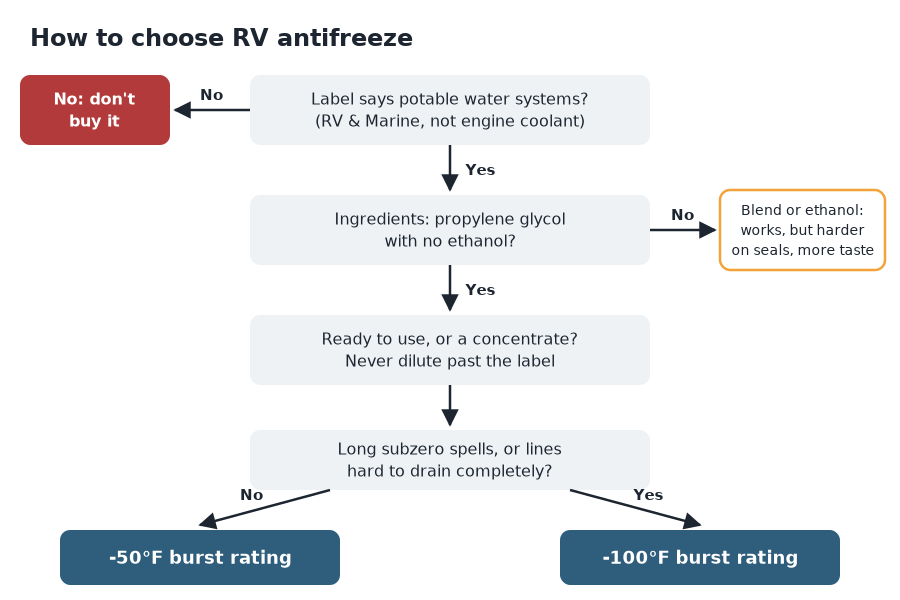 A quick way to choose: chemistry first, then the burst rating that fits your winter.
Which rating do you need?
- -50°F covers most US winters when you drain the system well first. It's the most common rating on the shelf.
- -100°F makes sense if you store the RV where long subzero cold spells are normal, if you can't drain every low spot completely, or if you just want more margin. Leftover water mixes with the antifreeze and weakens it, so the stronger product leaves more room for imperfect draining.
Ready-to-use or concentrate?
Most RV antifreeze sold in gallon jugs is ready to use: you pour or pump it straight from the jug. Star brite's -100°F PG product, for example, is labeled "no dilution required."
- Don't water down a ready-to-use product. Camping World specifically warns against mixing it 50/50 with water for winterizing. Diluting it raises the temperature at which it can stop protecting your lines.
- A few products are concentrates meant to be diluted. If the label gives a mixing ratio, follow it exactly and never dilute beyond it, as West Marine advises.
- Drain first. Draining the lines and low-point drains well before adding antifreeze keeps it from being diluted by leftover water.
How do you read an RV antifreeze label?
"RV & Marine" on the front doesn't tell you what's inside. Camping World points out that some jugs labeled "propylene glycol" are actually PG/ethanol mixtures, with PG listed first. Turn the jug around and check:
- Ingredients. Look for propylene glycol with no ethanol or ethyl alcohol. "Alcohol-free" or "ethanol-free" on the label is the quickest sign.
- Use statement. It should say it is for potable water systems or drinking water lines.
- Burst rating. -50°F or -100°F, as chosen above.
- Ready to use. Confirm whether it needs dilution.
RV Travel also raises a concern about PG made from recycled fluid, which might carry impurities you can't see on the label. If that worries you, look for products whose maker describes the PG as virgin or new, and stick with brands that sell specifically for potable systems.
How many gallons of RV antifreeze should you buy?
Camping World puts typical use at about 2 to 4 gallons per RV, counting what goes down the drains, when the water heater is bypassed. Larger rigs, extra bathrooms, washers and outdoor kitchens need more. Without a water heater bypass, the heater tank can take several extra gallons, which is why the bypass is part of our step-by-step RV winterizing guide.
- Buy one extra jug. Running out halfway through is more annoying than storing a spare.
- Don't fill the fresh water tank with it. Camping World notes the pump may need up to 10 gallons in the tank before it can draw, which wastes product. Pump straight from the jug with a converter valve or a hand pump.
- If you blow the lines out with compressed air, you still need some antifreeze for the P-traps and the toilet, since air doesn't clear them.
What should you never buy for an RV water system?
- Automotive antifreeze or engine coolant. Ethylene glycol is poisonous and must never go into RV plumbing.
- Windshield washer fluid, even if it's marked for cold weather.
- Anything without a potable-water statement, even if it's pink.
- Opened jugs of unknown age or contents left over from a previous owner.
What do you do with RV antifreeze in spring?
When you de-winterize, run fresh water through every faucet until it runs clear and the taste is gone, then sanitize the system with our bleach method for the fresh water tank. Camping World recommends draining used RV antifreeze into a dump station, septic system or residential sewer clean-out, even if the product says "biodegradable." Don't let it run onto the ground or into storm drains. If you're at a dump station anyway, it's a good time for a thorough black tank cleaning.
Common questions
Is RV antifreeze safe to drink?
No. It is made to be safe in drinking-water plumbing, not to be consumed by people or animals. Propylene glycol is far less toxic than automotive antifreeze, but keep jugs away from pets, flush the system thoroughly in spring and sanitize it before you drink from it again.
Does the color of RV antifreeze mean anything?
Not much. Most RV antifreeze is dyed pink or red, and some is blue, so you can see when it has reached a faucet and when it has been flushed out. The dye tells you nothing about the base chemistry or the rating, so read the ingredients and the burst rating instead.
Does RV antifreeze go bad?
It keeps for a long time, but Camping World puts the useful life of an opened jug at roughly 1 to 4 years. Store it sealed, out of the sun, and replace it if it looks cloudy or contaminated. Buying close to the amount you need each fall avoids the question.
Can I reuse RV antifreeze I drained in spring?
It's not a good idea. Fluid that has sat in your lines, traps and tanks for months is diluted and may be contaminated, so it no longer matches its label rating and doesn't belong back in a drinking-water system. Start each winter with fresh, sealed jugs.
Can RV antifreeze go in my engine's cooling system?
No. Plumbing antifreeze lacks the corrosion protection an engine needs and is not a coolant. Your motorhome or tow vehicle engine uses the coolant specified in its owner's manual, and that coolant must never go into the water system.
Sources
- Everything you need to know about RV antifreeze, Camping World
- Selecting antifreeze, West Marine (West Advisor)
- Will -50F antifreeze freeze solid in freezing temperatures when winterizing an RV?, etrailer
- What does alcohol free or ethanol based antifreeze mean when winterizing a travel trailer?, etrailer
- Not all RV antifreeze is created equal, RV Travel
- -100°F antifreeze for RV, boat and water system (product page), Star brite
RV systems vary by manufacturer and model. Always follow your owner's manual and appliance instructions; for propane, 120-volt electrical and structural work, use a qualified RV technician.